Minimum order quantities are the first wall most new buyers hit in Yiwu wholesale sourcing. You find the perfect ceramic mug, ask the price, and the answer comes back with a condition attached: this price, but you take at least ten cartons. This post explains where those minimums come from, the different shapes they take, and what your realistic options are when the minimum is bigger than your appetite. It deliberately does not walk the rest of the buying process. If you want the full route from product list to container, our step by step guide covers it, and this piece goes deep on this one step instead.
Why minimums exist at all
An MOQ is not a power play. It is arithmetic. Somewhere behind that booth, goods are either sitting in a warehouse in sealed cartons or being produced in runs on a machine, and both of those facts create natural units that are expensive to break.
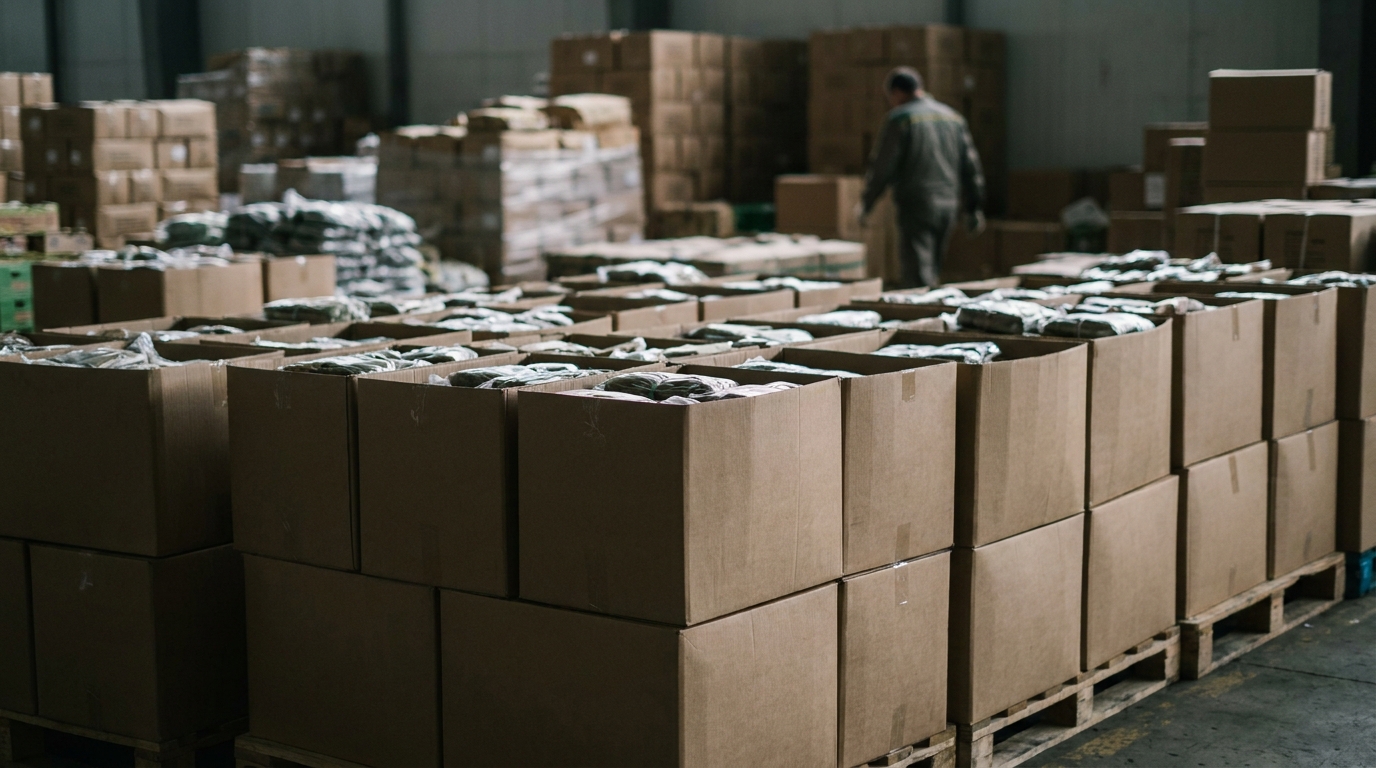
Take the packed carton first. A supplier’s hair clips might come 12 to an inner box and 24 inner boxes to a carton, so the carton holds 288 pieces. Opening a sealed carton to sell you 150 pieces creates a part-carton that is harder to store, harder to count and harder to sell. So the practical minimum becomes one carton, and often several, because the handling effort of a tiny order is the same as a medium one while the money in it is not.
Production runs work the same way at a larger scale. A machine gets set up for one colour of one design, and the setup time costs the same whether the run is short or long. Dyes are mixed in batches. Printing plates are made per artwork. All of this pushes the sensible minimum up, and the more customised the product, the harder it pushes.
The shapes an MOQ takes in Yiwu
Booths do not all express their minimums the same way, and it pays to know the common patterns before you ask.
- Per carton. The most common form for stock goods. One carton, two cartons, five cartons of a single item. The carton quantity is set by the packing, so a carton of 288 small clips and a carton of 12 large storage boxes are both “one carton”.
- Per design or per colour. A booth may happily sell a modest total quantity but want it concentrated: 600 pieces is fine, but 100 pieces each of six colours may not be, because each colour is its own production batch. Mixing within a carton is sometimes possible on stock goods and rarely on made-to-order ones.
- Per order value. Some booths think in money rather than pieces and will quote a minimum order amount in yuan. Below that number, the order is not worth their paperwork.
- Per customisation. The moment your logo, your colour or your packaging enters the picture, the minimum usually jumps, because now nothing can be pulled from stock and nothing left over can be sold to anyone else.
Ask the minimum at every booth even for identical products, because two neighbouring booths selling the same torch can carry different minimums depending on whether they hold stock, produce themselves, or order from a factory on demand.
Yiwu minimums compared with factory minimums
The reason Yiwu attracts smaller importers in the first place is that its minimums are generally lower than what a factory would ask for the same goods directly. A factory wants to fill a production run. A Yiwu booth often holds stock precisely so it can sell in cartons rather than in runs, and serving many small buyers is the business model. That is why an order of two cartons each across thirty different items, absurd to most factories, is a perfectly normal Yiwu order.
The trade-off is that stock goods come as they are. The colours, the packing and the printing were decided before you arrived. Low minimum and full customisation rarely live in the same booth, and a buyer who wants both is really asking for a factory relationship, with factory minimums attached.
What to do when the MOQ is too high for you
You have five realistic moves, and which one fits depends on the product and on why the minimum exists.
1. Ask what the minimum buys you
Sometimes the quoted MOQ is the minimum for the quoted price, not the minimum to do business at all. A booth may sell below its stated minimum at a higher unit price, especially on stock goods late in a season. It costs nothing to ask the question directly: “and if I only take two cartons?” The worst answer is no.
2. Consolidate designs instead of dropping the item
If the wall is per colour or per design, concentrate. Take 600 pieces in the two best colours instead of 100 each of six. Most buyers overestimate how much variety their own customers need, and the two best sellers usually carry the range anyway.
3. Buy from stock rather than to order
If the booth holds inventory, the carton on the shelf may be available in smaller quantity than a fresh production run of the same item would be. You give up choice of colour and packing, and you should check the stock’s condition, because a carton can sit a while. In our warehouse we have opened stock cartons where the goods were fine and the outer cartons were tired enough to need replacing before export, which is a repacking job, not a crisis.
4. Grow into the minimum on a later order
Booths remember buyers who return. A supplier who bends the minimum once for a new buyer is taking a small bet that a real customer is forming. If you intend to reorder, say so, and mean it. It changes the conversation more than any haggling does. What it does to price is a different matter, and our post on what is and is not negotiable in Yiwu deals with that honestly.
5. Accept that some products are not for you yet
This is the unpopular one. Injection-moulded goods with your own mould, printed packaging in small runs, deeply customised items: the minimums there are structural, and no amount of charm at the booth changes the economics of a mould. Park the idea, buy the near-equivalent from stock, and come back when your volumes have grown.
MOQs and the mixed container
Where Yiwu wholesale sourcing gets genuinely pleasant is that low per-item minimums let one container carry a whole shop. Thirty suppliers, two to five cartons each, everything delivered into one consolidation warehouse and loaded together. The minimums stop being a wall and become the packing list. Planning that kind of mixed container has its own guide on this site, so we will leave the loading maths there.
One practical note from the warehouse side: when you buy at or near minimums from many booths, deliveries arrive in dribs and drabs over days. Keep your own record of what each supplier owes, in cartons and in pieces, because a missing carton out of ninety is easy to overlook and annoying to discover at destination. We check deliveries in against order sheets for exactly this reason.
The questions to ask at the booth
To finish, the short list we actually use. At any booth, for any product, get these answered before you fall in love with the item:
- What is the minimum for this price, in cartons and in pieces?
- Is that per item, per colour, or per order?
- Is there stock now, and how much?
- If I order below the minimum, is there a price at which that works?
- What is the minimum if I want my own logo or packaging?
Five questions, two minutes, and you know whether this booth fits your order size before any negotiation starts. That is most of what mastering MOQs amounts to: asking early, so the minimum shapes your plan instead of ambushing it.