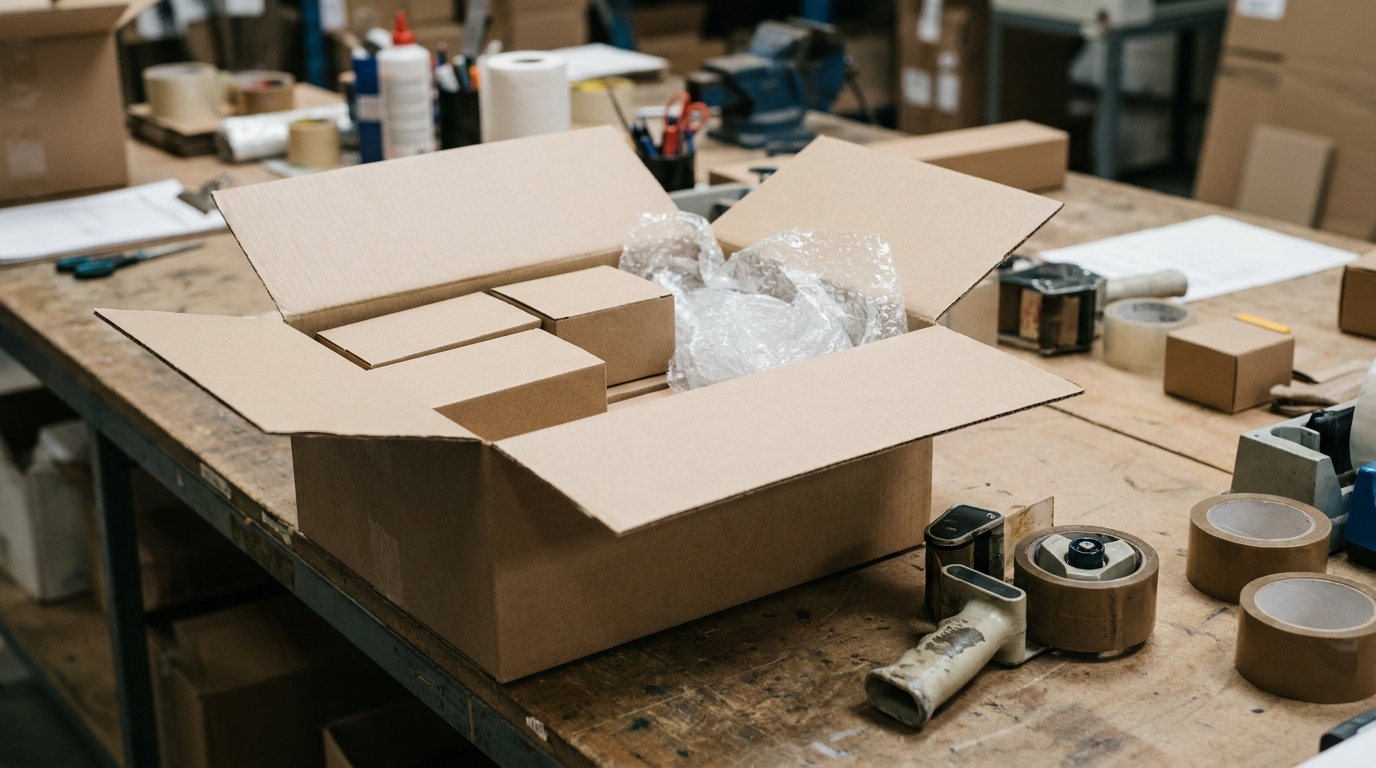
Buyers imagine their cartons travelling from the supplier’s hands to their own door untouched. In a consolidated shipment from Yiwu, that is often not what happens, and it is often not what should happen. Cartons get opened. Goods get repacked. Sometimes this saves a shipment, and sometimes, done carelessly, it is exactly how goods get damaged, miscounted and mixed up. This post is the honest version: why a Yiwu warehouse service opens cartons at all, what genuinely goes wrong when repacking is done badly, and how to brief a warehouse so it goes well. We open cartons in our own Yiwu warehouse most working days, so this is written from the floor, not from theory.
Why cartons get opened in the first place
There are five common reasons, and most shipments involve at least one of them.
Checking. The most basic reason. Receiving a delivery properly means opening at least a sample of cartons to confirm the goods, colours and counts match the order. An inspection goes deeper. Either way, tape gets cut.
Weak supplier cartons. Yiwu suppliers pack for a delivery van crossing town, not always for a container crossing an ocean and two more truck journeys. Thin single-wall cartons, reused cartons, cartons already softened by rain on the delivery bike. A carton that arrives at the warehouse looking tired will not improve during six weeks of transit with half a tonne stacked on it. Repacking into a proper export carton is the fix.
Half-empty cartons. Freight is priced substantially by volume, so a carton that is one third air is a carton you are paying to ship air in. Combining two loose-packed cartons into one well-filled one is routine, and across a large consolidation it meaningfully shrinks the shipment. The arithmetic behind that is in our CBM and container loading post.
Labelling and kitting. Barcodes on inner boxes, sets assembled from components bought from different booths, one supplier’s goods split across cartons destined for different addresses. All of it requires opening.
Removing what should not travel. Suppliers sometimes toss in their own flyers, price stickers in RMB on retail boxes, or spare parts loose on top. If your customer will open these boxes, that material needs to come out.
Inner boxes, and why they matter more than the outer carton
Most Yiwu goods are packed in layers: units inside inner boxes, inner boxes inside the export carton. A typical arrangement might be 12 pieces to an inner box, 12 inner boxes to a carton, 144 pieces per carton. The inner box is doing more work than it gets credit for.
It is the counting unit. Warehouse staff count inner boxes, not loose pieces, so intact inners are what make counts fast and reliable. It is the protective unit. A dozen glass candle holders separated by an inner box and its dividers survive handling that loose-packed ones will not. And it is often the selling unit: many buyers sell on by the inner box, so a crushed or torn inner is damaged stock even when the product inside is fine.
This is why the first rule of good repacking is simple: repack by moving sealed inner boxes, and leave them sealed. The moment loose units start migrating between cartons outside their inners, counting errors and damage both become likely. If work must happen at unit level, for example labelling each piece, it should be treated as a slower, more careful, separately agreed job.
What goes wrong when repacking is done badly
Honesty section. These are the real failure modes, all of them preventable and all of them seen in the wild:
- Counts drift. Two cartons of 90 become one carton of 176, and nobody notices the missing four until destination. Loose repacking without recounting is the usual cause.
- SKUs get mixed. Similar products from the same supplier end up combined in one carton with a label naming only one of them. The packing list is now wrong, and a customs examination or a warehouse pick at destination turns confusing.
- Retail packaging gets scuffed. If the giftbox is the product, as it is for much of what Yiwu sells, then tape pulled across print, boxes compressed to close a carton, or inners restacked under pressure all create damage that no one records as damage.
- Sets get separated. Kitted goods split back into components because the person repacking did not know they belonged together.
- The paperwork stops matching the cargo. The original carton numbers die when cartons are combined, and if the packing list is not rebuilt at the same moment, the shipment’s paper trail quietly breaks.
Notice that none of these are exotic. They are what happens when repacking is treated as casual labour instead of as a controlled step with rules, records and photographs.
How to brief a warehouse so it goes well
The difference between good and bad repacking is mostly decided before the first carton is opened, in the instruction. A good repacking brief covers six things:
- What may be opened and what may not. If certain goods must ship exactly as the supplier packed them, sealed retail master cartons for instance, say so explicitly. A do-not-open list is short and prevents the most annoying category of surprise.
- The inner box rule. State that repacking moves sealed inner boxes only, and that any unit-level work is to be raised with you first.
- Target carton weight. Cartons that a person will lift repeatedly should stay liftable. Agree a sensible maximum weight per carton with the warehouse for your goods, rather than letting dense products be packed to the point of injury and drop damage.
- Materials. New double-wall export cartons for anything travelling far, proper tape, and void fill where cartons cannot be completely filled. A repacked carton with a fist of empty space at the top will be crushed from above in the stack.
- Photos before and after. Each opened carton photographed as found and as resealed. This costs minutes and settles arguments that would otherwise cost weeks.
- The paperwork rule. Every repack updates the packing list at the moment it happens: new carton numbers, contents, counts, weights, dimensions. The marking that then goes onto those new cartons has its own post, and the same principle runs through both: paper and cargo must agree.
Send this once, keep it on file, and let it apply to every shipment. Warehouses, ours included, work far better against a standing written instruction than against assumptions reconstructed after something has gone wrong.
When the right answer is not to repack
A fair warehouse will also tell you when repacking is not worth it. Goods in strong, well-filled supplier cartons gain nothing from being disturbed. Fragile items professionally packed at a factory are often safer in their original arrangement than in anyone’s rearrangement. And when the saving is a fraction of a cubic metre against the risk of handling damage on delicate stock, leaving cartons sealed is the better trade. Opening a carton is a tool, not a default.
If your goods are coming through Yiwu and you are unsure which of them should be repacked, checked or left alone, contact us. We run our own warehouse and consolidation space in Yiwu with our own staff, we will give you a straight opinion per product, and we are comfortable when that opinion is “do not touch these”.