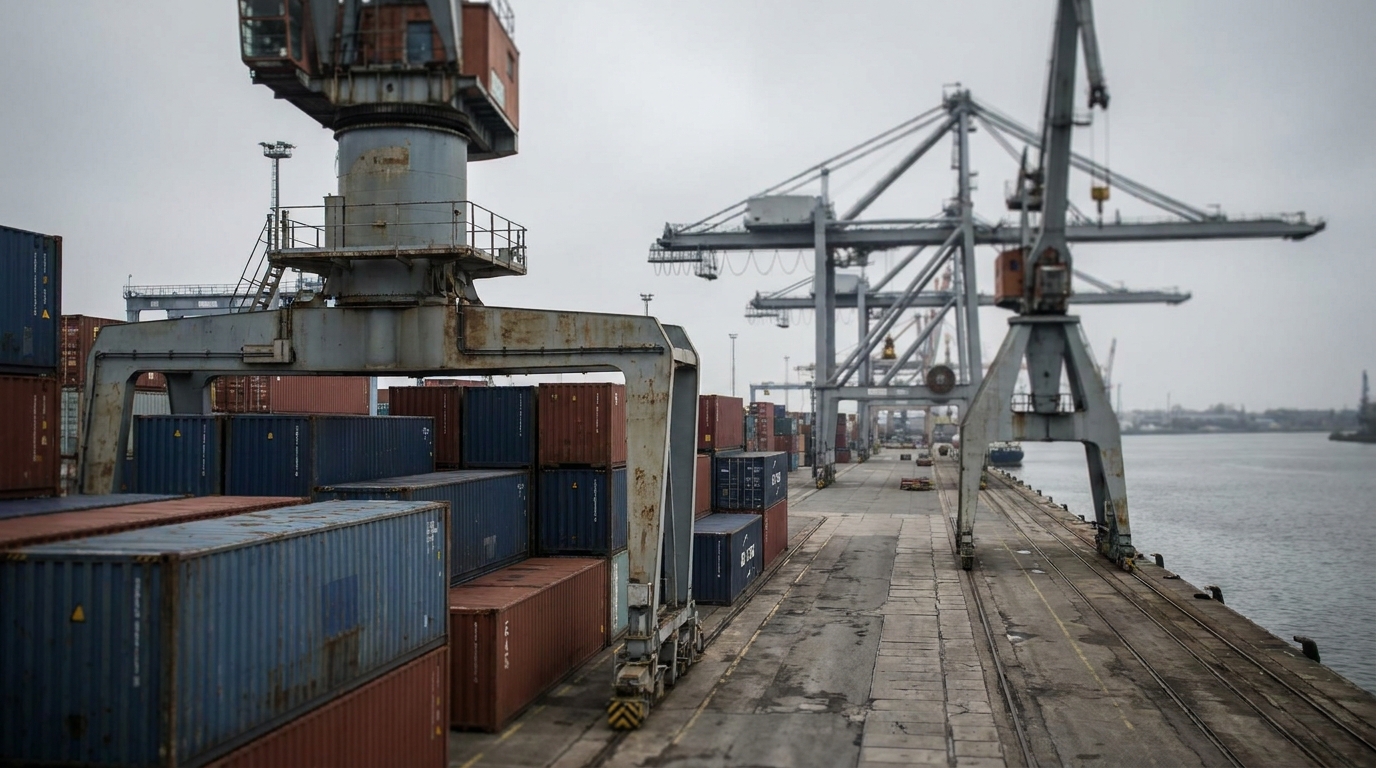
Yiwu has one of the largest wholesale markets in the world and no seaport. That single fact shapes almost everything about how goods leave the city. Whatever you buy in Futian market, if it is going by sea it first has to travel overland to a port, and in practice that means Ningbo or Shanghai. Part of the job of a Yiwu shipping agent is managing that inland leg well, because it is where cut-offs are missed and where avoidable costs creep in. This post explains how cargo actually moves from a Yiwu warehouse to a vessel, and how the choice between the two ports usually gets made.
If your shipment is still at the stage of being collected from many suppliers, that is consolidation, and we cover it separately. Here we pick up at the point where the goods are checked, packed and ready to leave the warehouse.
Why Ningbo and Shanghai carry almost all of it
Ningbo sits on the coast of the same province as Yiwu, Zhejiang. The port complex there, often written as Ningbo-Zhoushan, is one of the busiest container ports anywhere, and the road between Yiwu and Ningbo is a well worn freight corridor. Trucks make the run every day of the week, and for most Yiwu cargo Ningbo is the default exit simply because it is the nearest deep water port with sailings to almost every major destination.
Shanghai is further from Yiwu, so the trucking leg is longer and usually costs more. It stays in the picture for two reasons. First, some destinations and some sailing schedules are served better out of Shanghai in a given week. Second, when one port is congested, the other becomes the relief valve. A forwarder quoting your shipment will often price both and let the schedule decide.
Neither port is better in any absolute sense. The honest answer is that for a buyer the difference is mostly invisible. Your goods leave the same warehouse, ride a similar truck, and end up on a vessel either way. What matters is that whoever books the shipment compares the options for that week rather than defaulting out of habit.
The two ways cargo physically leaves Yiwu
There are two basic patterns, and which one applies to you depends on whether you fill a container on your own.
Full container loads
If your goods fill a 20ft or 40ft container, the container itself usually comes to Yiwu. An empty box is collected from a depot, trucked to the warehouse, loaded at the door, sealed, and then driven to the port as a single unit. You get a seal number, and that seal should not be touched again until the container reaches you or your agent at destination. How the loading itself is planned, and how CBM works, is a topic we cover in a separate post on container loading, so I will not repeat it here.
The advantage of loading in Yiwu is control. The people who checked your goods are the same people watching them go into the box, and there is no intermediate handling between the warehouse floor and the ship.
Less than container load
If your shipment is a few CBM rather than a full box, it travels as LCL. Your cartons are trucked to a container freight station, where they are combined with cargo from other shippers into a shared container. This is normal and there is nothing wrong with it, but be clear about what it means: your goods are handled more times, by people who have never seen your order sheet, alongside freight you know nothing about. Sturdy outer cartons and clear marking matter more for LCL than for anything else you will ship.
The timeline, working backwards from the vessel
Sea freight runs on cut-offs. A vessel has a documentation cut-off and a cargo cut-off, and if either is missed the shipment rolls to the next sailing. That is often a week lost for the sake of a few hours.
So the planning runs backwards. The vessel sails on a certain day. The container must be in the port before the cargo cut-off, typically a day or more earlier. The truck from Yiwu must be loaded and gone in time to allow for the road, for queues at the terminal gate, and for something going slightly wrong. Which means the goods must be fully received, checked and ready in the warehouse before that. A Yiwu shipping agent spends a surprising amount of time on exactly this arithmetic, chasing the one supplier whose late delivery threatens the whole chain.
My advice to buyers is simple. Do not book the tightest possible schedule when one supplier is still unconfirmed. The saving from catching an earlier vessel is small. The cost of missing it, with goods sitting packed and a customer waiting at your end, is not.
Export formalities happen on this leg
Somewhere between the warehouse and the vessel, the export side paperwork is handled. Yiwu itself has an inland freight and clearance facility, and depending on how a shipment is booked, some steps happen there and some at the port. I am deliberately not going to describe the procedure in detail, because it is handled by the forwarder and the agent, it changes, and it is not something a foreign buyer needs to operate personally. What you should take from this section is narrower: export formalities in China are part of the service you are paying for, and import formalities in your own country are not. Customs clearance, duties and any import requirements at destination are yours to arrange and pay, and the rules vary so much by country and by product that the only sensible source is your own customs broker or authority. Nothing in this post is customs advice.
What can slow the inland leg down
The Yiwu to port corridor is short by China standards, but it is not immune to friction. A few things come up often enough to plan around:
- Holiday crush. In the weeks before Chinese New Year every warehouse, truck and terminal is at capacity. Bookings that would be routine in April become tight in January. Plan extra margin.
- Weather. The Zhejiang coast sees typhoons in late summer, and a storm can close a port for days and scramble schedules for longer. Nobody controls this, so the only defence is slack in your timeline.
- Port congestion. It comes and goes. When it appears, the Ningbo or Shanghai question sometimes answers itself.
- Inspection holds. Occasionally a container is selected for checking before export. It is normal, it happens to compliant cargo too, and it usually costs days rather than weeks. Build the possibility into your expectations rather than treating it as a crisis.
What to actually ask your agent
You do not need to become a freight expert to ship well from Yiwu. You need a few concrete answers before the goods move. Which port is this shipment routed through, and why. What is the cargo cut-off, and what date does the warehouse need everything in hand. Who is the forwarder and who issues the bill of lading. What happens if one supplier is late, and at what point do we decide to ship without them.
An agent who answers those questions in plain terms, with dates, is doing the job. The trucking leg from Yiwu to Ningbo or Shanghai is short, but it is the hinge between the market and the sea, and shipments are won or lost on it more often than on the ocean itself. Get the inland leg right and the rest of the voyage is mostly waiting.
If your order is too small for sea freight to make sense at all, air and express options are a different conversation, and we cover those in their own post.