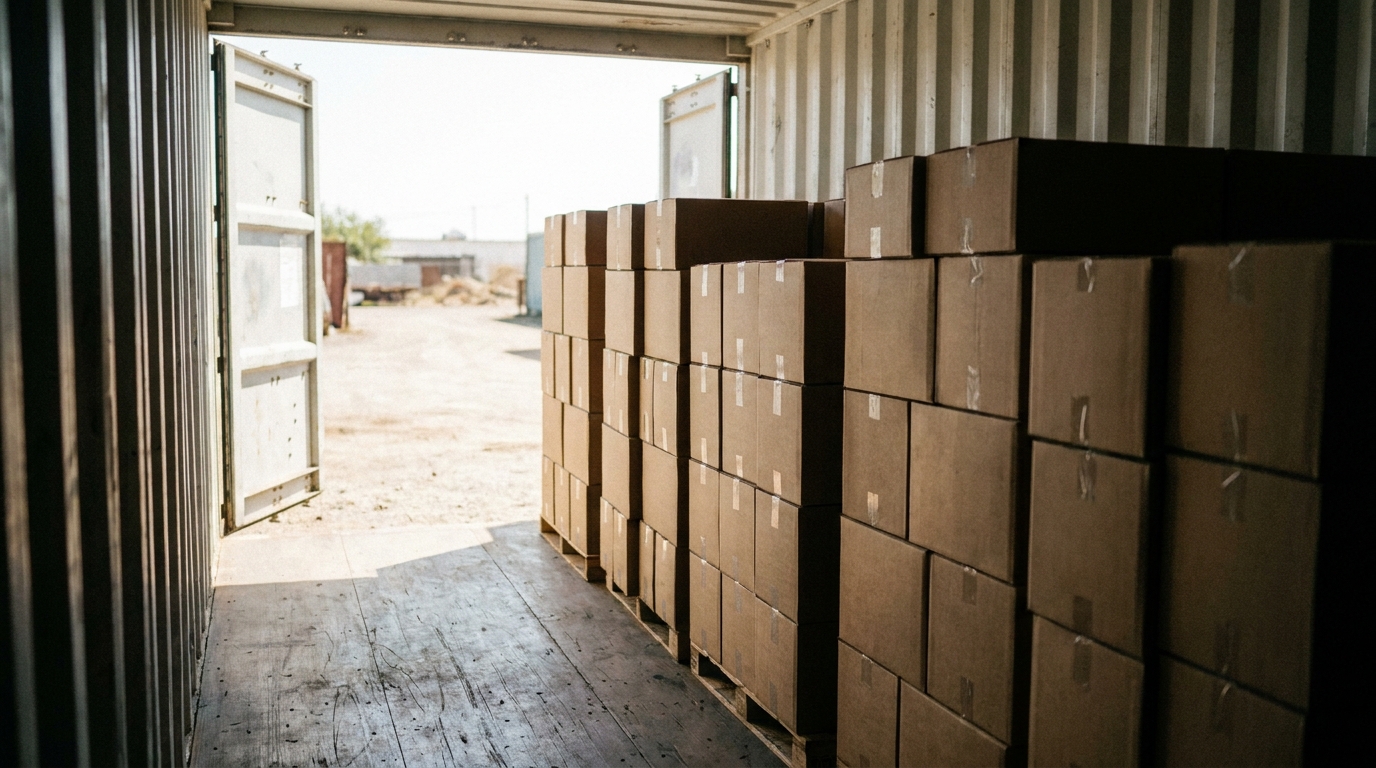
Sooner or later every Yiwu buyer meets three letters: CBM. Suppliers quote carton sizes in it, warehouses report your shipment in it, and freight is largely priced by it. If you understand CBM, container planning becomes arithmetic you can do on a napkin. If you do not, you are guessing, and guesses about container space are expensive in both directions. This post covers the arithmetic as we use it in Yiwu sourcing and consolidation work: how CBM is calculated, roughly what containers hold, and why a container never quite holds what the brochure says.
What CBM is and how to calculate it
CBM stands for cubic metre. One CBM is a cube of one metre by one metre by one metre. To get the CBM of a carton, multiply its length by its width by its height, all in metres.
Take a real example. A carton of 60cm by 40cm by 35cm is 0.6 x 0.4 x 0.35 = 0.084 CBM. Order 200 of those cartons and your shipment is 16.8 CBM. That is the whole calculation. The traps are all in the inputs:
- Measure the outside of the carton, packed. A stuffed carton bulges. A carton quoted at 35cm high can measure 38cm once full, and across two hundred cartons that difference is real space.
- Use the supplier’s export carton, not the sample box. Suppliers often quote a carton size from memory. The number that matters is what the warehouse measures when the goods physically arrive.
- Watch the units. Sizes get passed around in centimetres and calculated in metres. One slipped decimal turns 0.084 into 0.84 and your planning is off by a factor of ten. It happens more than anyone admits.
This is one reason a consolidation warehouse measures and weighs every incoming delivery. In our warehouse in Yiwu, measured dimensions go into the shipment record as goods arrive, so the running total is built from real cartons rather than supplier estimates.
Roughly what containers hold
Sea containers come in standard sizes, and for planning purposes the working figures most people in the trade use are:
- A 20ft container: roughly 28 usable CBM.
- A 40ft container: roughly 58 usable CBM.
- A 40ft high cube: roughly 68 usable CBM.
Treat these as approximate working figures, not promises. The internal volume of the steel box is a little higher than each of those numbers, but you can never use all of it, for reasons the next section explains. Real usable capacity depends on your carton sizes, how they stack, and how the container is loaded. A shipment of uniform, well-sized cartons might do better than the working figure. A shipment of awkward mixed cartons will often do worse.
Weight is the other ceiling, and people forget it. Containers and the roads they travel on have weight limits, and dense products such as tiles, hardware, or paper goods can hit the weight limit long before the box looks full. The specific limits depend on the container, the route and the destination’s road rules, so confirm them with your forwarder rather than working from a number in a blog post. The practical habit: track your shipment’s total weight alongside its CBM, and ask early if you are shipping anything dense.
Why you cannot use every cubic metre
The gap between a container’s internal volume and what actually fits is not carelessness. It is geometry:
- Cartons are rectangles and the container is a fixed rectangle, so unless your carton dimensions divide neatly into the container’s, every row ends with a gap.
- Mixed consolidations contain many different carton sizes, which stack imperfectly against each other. Uniform cargo packs tighter than variety.
- Crushable cartons cannot be stacked to the ceiling with heavy cargo above them, so some vertical space above soft goods stays empty on purpose.
- The last metre by the doors is loaded standing inside a narrowing space, and often carries the odds and ends, less tightly than the rest.
- Palletised cargo trades space for handling speed. Pallets themselves consume volume, and pallet stacks rarely reach the ceiling.
A good loading crew makes real differences here. Loading a mixed container well is closer to a puzzle than a chore: heavy uniform cartons build the floor, mid-weight goods fill the middle, light and fragile cargo rides high, and small cartons plug the gaps as they appear. This is manual, sweaty work done in an hour or two against a truck schedule, and it is one of the places where having your own people at the warehouse door pays off.
Using the numbers to make decisions
The point of tracking CBM is the decisions it lets you make before they are made for you.
The first decision is shipment size versus container size. If your consolidated total is heading for 24 CBM, you are in comfortable 20ft territory. If it is heading for 33 CBM, you have a genuine choice: trim the order back toward a 20ft, grow it toward a 40ft, or ship the overflow separately as loose cargo. Each option has costs, and the earlier you see the number coming, the cheaper the choice is. This is also where ordering decisions and shipping decisions meet, and if you are planning a container across many suppliers from the start, our post on planning a mixed container from Yiwu covers that end of it.
The second decision is per-product judgement. Because freight is largely driven by volume, CBM tells you what shipping adds to each unit. If a carton of 0.084 CBM holds 300 hair clips, each clip carries a tiny slice of the freight. If the same carton holds six bulky plush toys, each toy carries fifty times that slice. Buyers are regularly surprised that a cheap, bulky product lands costing far more than its market price suggested, and a two-minute CBM check at ordering time is what prevents the surprise.
The third is packing efficiency. Sometimes a supplier’s standard carton is half air, and repacking into tighter cartons meaningfully shrinks the shipment. Whether that is worth doing, and what can go wrong when cartons are opened, is its own subject and we cover it in the repacking post.
Where the warehouse hands over
Once the container is loaded and sealed, or the loose cargo is handed to the forwarder, the volume story is over and the transport story begins: trucking to Ningbo or Shanghai, bookings, documents, the rail option to Europe. Those belong to the shipping side of this blog and have their own posts. The warehouse side’s contribution is the part covered here: real measurements from real cartons, a running CBM and weight total you can see, and a load plan that gets as much of your cargo into the box as its shape allows.
If you are trying to work out what your product list adds up to in cubic metres, or which container it points to, contact us. Yiwu sourcing and consolidation is what we do, our warehouse measures cargo every working day, and this particular arithmetic is quick when the real carton sizes are in front of you.