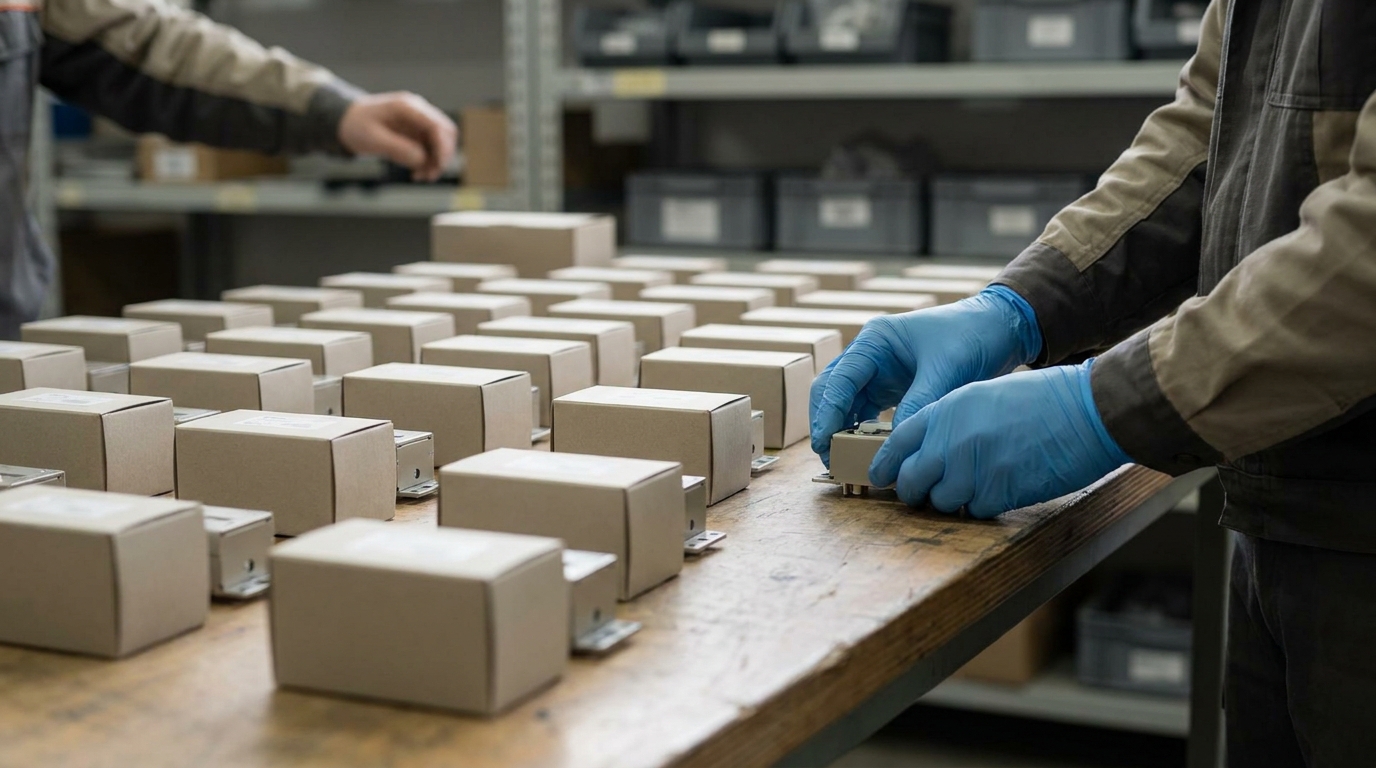
People imagine an inspection as a person opening every carton and examining every piece. That almost never happens, and it would not be worth paying for if it did. A Yiwu quality inspection service works differently: it pulls a sample from the finished order, checks that sample against an agreed standard, and tells you what it found. Done properly, that is enormously useful. It is also more limited than many buyers assume, and the limits matter as much as the checks, so this post covers both.
We inspect goods as part of our sourcing work in Yiwu, usually in our own warehouse once cartons arrive from suppliers, sometimes at the supplier’s premises before the balance is paid. What follows is what a normal inspection on general merchandise actually involves, item by item.
First, the boring part: counting
Before anyone looks at product quality, the inspector counts. How many cartons arrived against the packing list. Whether carton weights are roughly consistent, because one carton that weighs a kilo less than its neighbours often means missing inner boxes. Then a sample of cartons gets opened and the inner quantities are counted against what the supplier promised. A carton marked 240 pieces that holds 20 inner boxes of 10 is a real thing that happens, and it is far cheaper to catch in Yiwu than in your own warehouse after you have already sold the stock on paper.
Counting sounds trivial. On mixed orders from several booths it is often where the first problems show up.
Checking the goods against an agreed standard
An inspection is only as good as the standard behind it. If all you gave the supplier was a verbal “same as the sample”, the inspector has very little to hold anyone to. The useful setup is a retained sample, ideally one both sides signed off, plus a short written spec: material, dimensions, weight, colour reference, printing, packaging, and any function the product must perform. With that in hand, the checks are concrete rather than a matter of taste.
On the sampled pieces, an inspector typically looks at:
- Appearance and workmanship. Scratches, sink marks in plastic, glue residue, loose threads, uneven plating, crooked printing, sharp edges left from moulding. Cosmetic defects are usually graded by severity rather than treated as one bucket, because a faint mark on the base of an item is not the same problem as a scratch across its face.
- Colour and finish against the reference. Side by side with the retained sample, in decent light. Colour drift between production lots is one of the most common findings on Yiwu goods, especially textiles and painted items.
- Dimensions and weight. A tape measure and a scale catch a surprising amount, including the quiet substitution of a lighter material.
- Basic function. Zips run, lids fit, wheels turn, pumps spray, lights switch on, seams hold under a firm pull. For battery items, that batteries are present if promised, and that the item powers up.
- Assembly and completeness. All parts present, screws included, instructions included where agreed.
Packaging, labelling and barcodes
Packaging gets its own pass because packaging errors are expensive in a different way. The inspector checks that the retail packaging is the agreed version, that any printed text is the text you approved rather than the supplier’s stock artwork, that labels carry the right content, and that barcodes scan and resolve to the right number. A barcode that prints fine but scans as the wrong code is a genuinely painful discovery to make at a retailer’s goods-in desk instead of in a warehouse in Zhejiang.
Carton quality is checked too. Thin single-wall cartons that are already soft in the warehouse will not enjoy a month at sea. If cartons need shipping marks, those are verified against the marking instructions.
How sampling actually works
Now the part that separates a real inspection from a comforting ritual. Inspectors do not check everything. They draw a random sample whose size depends on the total quantity, examine those pieces carefully, and use the result to judge the whole order. AQL, which stands for acceptable quality limit, is the sampling standard most of the industry uses to decide how many pieces to pull and how many defects of each severity would make the batch fail the check. Defects are usually sorted into critical, major and minor, and each class gets its own tolerance.
The logic is statistical. If a properly random sample of a few hundred pieces contains almost no serious defects, it is reasonable to believe the batch as a whole is in decent shape. If the sample is riddled with problems, the batch almost certainly is too. Which severity thresholds to apply is a commercial decision that depends on your product, your market and your appetite for cost, and it is something to agree before the inspection, not after. We can advise on what is customary for a given product type, but there is no single correct setting and we will not pretend there is.
What sampling cannot tell you
This is the section most inspection marketing leaves out.
A passed inspection does not mean the order is defect free. It means a random sample met the agreed threshold, so defects beyond that threshold are unlikely, not impossible. Some defective pieces can and usually do exist in any large production run of inexpensive goods. Sampling is a way of managing that reality, not abolishing it.
An inspection also cannot see faults that have not happened yet. Plating that will tarnish after two months in a humid stockroom, plastic that will crack in a cold delivery van, print that fails after fifty wash cycles: a one-day check of finished goods will not reveal any of that unless a specific test is arranged for it. Some accelerated tests exist for some properties, but they are separate exercises with their own costs and their own limits.
And an inspection is not a compliance certificate. Checking that goods match your sample says nothing about whether they meet the regulations of your market. Testing against a formal standard is laboratory work, ordered separately, and confirming what your market requires is your responsibility as the importer. We say this plainly because buyers sometimes treat an inspection report as a legal shield, and it is not one.
What you get, and what happens next
The output is a report: quantities found, checks performed, defects photographed and classified, measurements recorded, and an overall pass or fail against the agreed criteria. Good reports are heavy on photographs, because a picture of a crooked print settles an argument faster than three emails.
A failed check is not the end of the story, it is the start of a negotiation. Options usually include rework or replacement by the supplier, sorting out the defective portion, a price adjustment, or in bad cases rejecting the goods. This is exactly why timing matters, and why inspecting before the balance payment leaves you in a far stronger position. We cover the timing question separately in our post on when to inspect a Yiwu order.
Our own view, having done this for a while: the inspection itself is the visible part, but most of its value is created earlier, when the spec is written and the sample is sealed. A Yiwu quality inspection service with a clear standard to check against will catch most of what can be caught. Without one, even a diligent inspector is mostly guessing at what you meant. If you want help setting that up before your next order, that is a normal part of what we do, and you can reach us on WhatsApp at +86 136-6892-2294 or by email at info@sourcingagentyiwu.com.