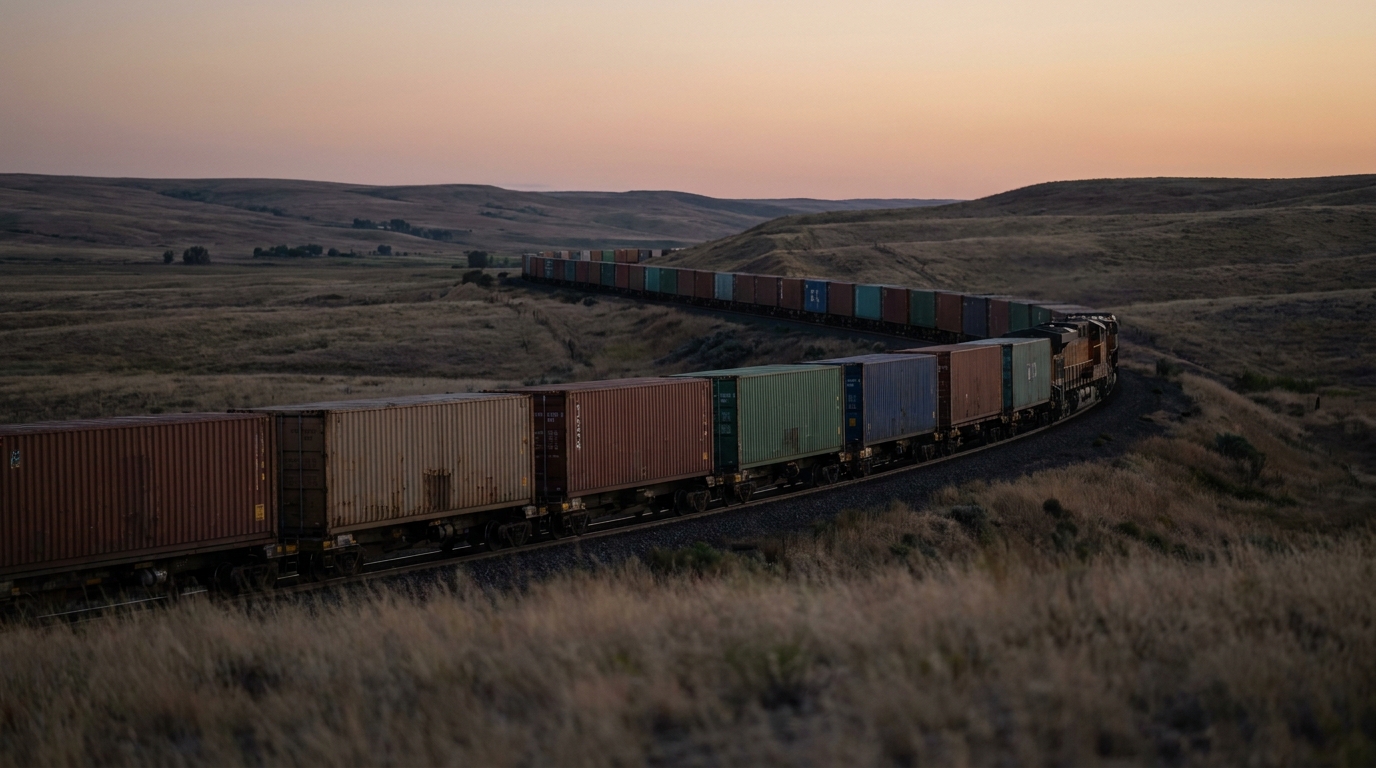
Most goods bought in Yiwu leave China by sea, and small urgent orders go by air. Between those two sits a third option that many buyers have heard of but few have used: rail. Container trains run from a rail terminal in Yiwu westwards across the continent to hubs in Europe, and for the right kind of shipment they are genuinely useful. As a Yiwu export agent we get asked about rail more every year, usually by European buyers who want their goods faster than the sea allows but cannot justify air freight for the weight involved. This post explains what rail freight from Yiwu actually is, what it is good at, and where it disappoints.
One thing before we start. This is a logistics post. Rail lines to Europe cross many countries, and questions about trade policy or anything political are simply not our subject. We are describing a way to move cartons, nothing more.
What the service actually is
Yiwu has its own rail freight platform on the edge of the city, and container trains depart from it toward Europe. The best known route runs all the way to Spain, and there are services toward other European destinations as well, with schedules that change over time. Your goods travel in a container, much like sea freight, loaded either as a full container or as LCL cargo sharing a box with other shippers.
The practical shape of the journey is this. The container is loaded in Yiwu, travels by train across China, crosses the border, continues across the continent, and arrives at a European rail hub. From there the container or your cartons move by truck to the final address. One mechanical detail worth knowing is that railways in different regions use different track gauges, so at certain border points containers are lifted from one train onto another. This is routine, it is handled by the operators, and you will never see it, but it is one of the reasons the journey has more handling steps than a single ocean voyage.
Where rail sits between sea and air
The simplest way to place rail is on two axes, speed and cost. On speed, rail is typically faster than sea to Europe and slower than air. On cost, it typically sits between the two as well, cheaper per kilo than air and more expensive than sea. I am deliberately not quoting numbers, because rates move constantly and any figure printed here would be wrong within months. Transit times also vary with the season, the route and conditions along it, so treat any schedule as typical rather than promised, and ask for the current picture when you book.
That middle position defines who rail is for. If your goods are cheap, heavy and not urgent, sea remains hard to argue with. If you have thirty kilos of samples, air wins. Rail earns its place when you have a real volume of cargo, a few CBM up to full containers, and a commercial reason to receive it sooner than a sea shipment would arrive. Seasonal goods are the classic case. A buyer of festive stock who is late for the water has, in some years, saved a season by putting part of the order on a train.
What ships well by rail, and what does not
Most general merchandise from Yiwu travels by rail without drama. Toys, textiles, homeware, bags, stationery, the ordinary run of market goods. There are two categories of exception to think about.
The first is restricted goods. Every transport mode has rules about what it will carry, and rail operators publish their own lists of goods that are excluded or need special handling. Batteries, liquids, aerosols, magnets and similar items need checking before you assume they can travel. Do not guess. Tell your agent exactly what the product is, including what is inside it, and let the operator confirm.
The second is temperature. A container on a winter train crosses regions where the cold is severe, and in summer a steel box in the sun gets hot. Most goods do not care. Liquids that freeze, cosmetics, candles, certain adhesives and anything with a narrow storage range do care, and this is a real difference from sea freight, where temperatures swing less. If your product would be unhappy in a very cold or very hot warehouse for a couple of weeks, raise it before booking.
How booking works from the Yiwu side
From the buyer’s point of view, a rail shipment is arranged much like a sea shipment. Your goods are consolidated in the warehouse, checked, and packed. The agent or forwarder books space on a departure, the container is loaded and moved to the rail platform, and a rail consignment document is issued for the shipment. Departures run to a schedule, so like sea freight there are cut-offs, and the same advice applies: do not build your plan around the earliest possible train while one supplier is still unconfirmed.
Documents for a rail shipment follow the same logic as any other export, an invoice, a packing list and the transport document, and we go through all of that in a separate post on shipping documents. On arrival in Europe, import formalities apply exactly as they would for a sea container. Customs clearance, duties and any product requirements in the destination country exist, they vary by country and by product, and you confirm them with your own broker or customs authority. Nothing here is customs or legal advice, and no transport mode changes what you owe at your end.
The honest downsides
Rail is a good tool, not a magic one, and it has real limitations worth stating plainly.
- Capacity is finite. Trains carry far fewer containers than a vessel, and in busy periods space sells out. The flexibility to shift a booking by a few days is smaller than at sea.
- Schedules are less dense. Miss a sea sailing from Ningbo and another follows within days. Departures on a given rail route can be weekly or less, so a missed cut-off costs more calendar time.
- Transit varies. Congestion at border transfer points can add days, sometimes more, and there is little anyone in Yiwu can do about it once the train has left.
- Coverage is uneven. Some European destinations connect well to the rail hubs, others need a long final trucking leg that eats into the time saved.
None of this makes rail a bad choice. It makes it a choice you should take with current information rather than a brochure from two years ago.
Deciding whether it fits your order
When a buyer asks us whether their shipment should go by rail, the questions we work through are short. How many CBM is it. When do you truly need it, not ideally but truly. Is anything in the order restricted or temperature sensitive. Where in Europe is it going, and how far is that from a rail hub. What do sea and rail actually cost for this shipment this month, side by side.
Run those five questions and the answer usually declares itself. A Yiwu export agent who ships regularly can get the rail and sea quotes in the same conversation, so there is no cost to asking for both. The buyers who are happiest with rail are the ones who used it deliberately, for a shipment where the weeks saved had a value they could name. The unhappy ones are usually those who expected air speed at sea prices, which no train has ever delivered.