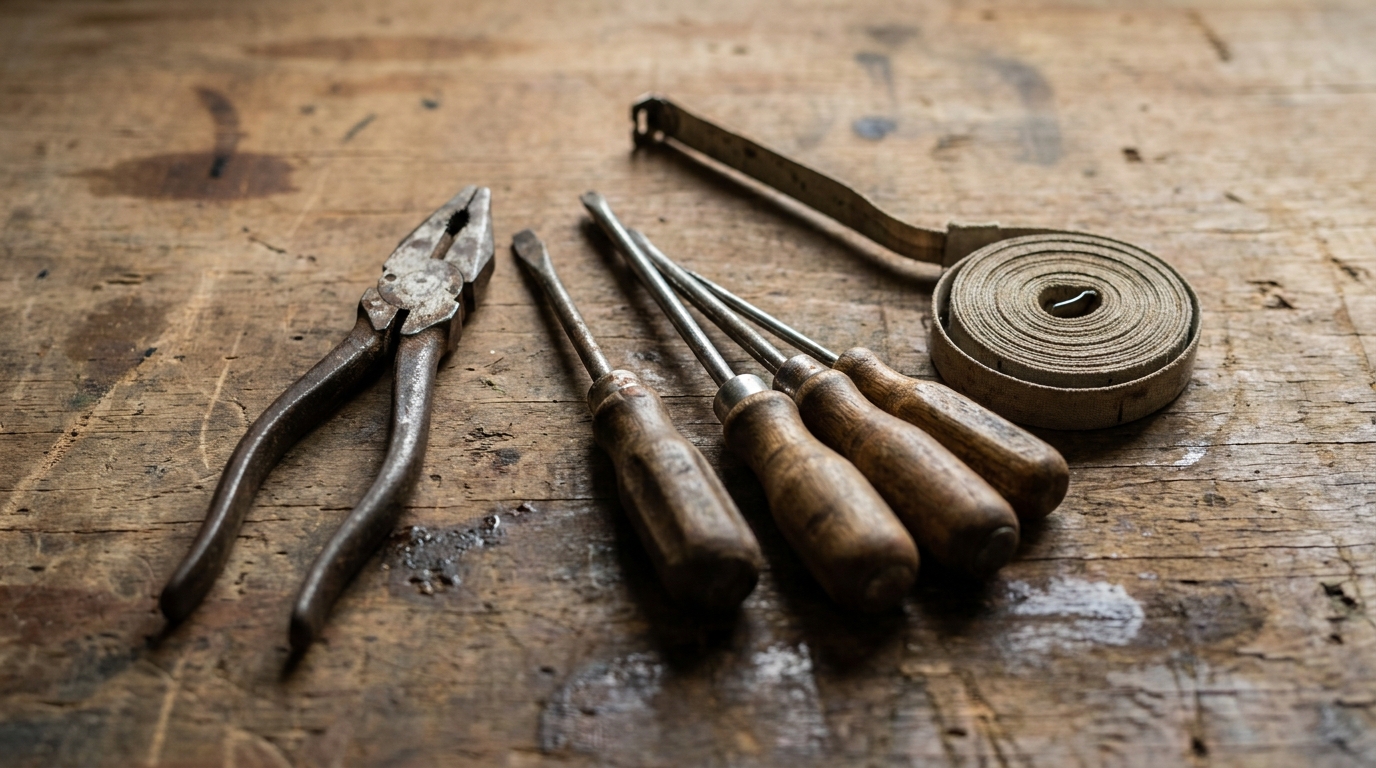
Hardware and hand tools are a category where Yiwu surprises buyers in both directions. The range is wider than most people expect, and the traps are more specific than in almost any other product world. A Yiwu supplier search for tools is not like one for party goods or stationery, because the things that matter most about a spanner or a pair of pliers are exactly the things you cannot see when you pick one up at a booth. This guide covers what the market genuinely offers, what you can and cannot verify on the spot, and the handful of problems that come up on hardware orders over and over.
One thing before we start. We do not make claims about safety, load ratings or compliance with any standard, for this category or any other. Those questions belong to testing labs and to the rules of your own market, and you should treat any blog that answers them casually with suspicion.
What Yiwu actually offers in this category
The hardware floors sit mainly in District 2 of Futian market, and we describe that geography in a separate article, so here it is enough to say the aisles are dense, repetitive and easy to underestimate. The strength of Yiwu in tools is breadth at the consumer and light trade end. Screwdriver sets, pliers, adjustable spanners, socket sets, hammers, utility knives and blades, tape measures, spirit levels, hex key sets, drill and driver bit sets, garden hand tools, staple guns, tool bags, tool boxes, and the endless world of fastener assortments in blister packs and plastic organiser cases.
What Yiwu is not is a source for precision industrial tooling or heavy machinery. Booths also sell power tools, but powered products bring electrical requirements that vary by destination market and sit outside what this article covers. If your business is hand tools for retail shelves, market stalls, promotional sets or general trade, the market fits. If your business is torque wrenches for workshops that calibrate them, you are shopping in the wrong city.
Steel claims you cannot check by looking
Walk the tool aisles and you will hear the same words at every booth. Chrome vanadium. Carbon steel. Heat treated. Hardened tips. Sometimes the words are stamped into the shank of the screwdriver itself, which feels reassuring and proves nothing beyond the fact that the mould contained those letters.
This is the central problem of the category. Two screwdrivers can look identical in the display case, weigh the same, feel the same in the hand, and behave completely differently the first time someone leans on them. Grade and hardening claims are cheap to make and expensive to verify, and you cannot verify them by eye, by touch or by asking twice.
What you can do is treat the claim as unverified until you have your own evidence. Use the production samples hard yourself. Drive screws into real timber, grip and twist with the pliers, drop the tape measure a few times. Compare against a tool you already sell and trust. For a line you intend to reorder for years, paying a testing lab to look at the material is a real option, and a supplier who reacts badly to that idea has told you something useful. And when you write your own product listings, do not repeat the booth’s material wording as your own claim unless you have checked it, because once it is on your packaging it is your claim, not theirs.
Plating, oil and the humid weeks at sea
A polished spanner in an air conditioned showroom is one object. The same spanner after four or five weeks inside a steel container that has crossed the equator is potentially a different one. Container interiors swing between hot days and cool nights, moisture condenses, and bare steel or thinly plated surfaces can arrive with spotting that no customer will accept.
The defences are boring and they work in combination rather than singly. A film of anti rust oil applied before packing. VCI paper or bags around the metal, which release a vapour that slows corrosion inside the sealed pack. Desiccant sachets in the carton. Sealed inner bags rather than tools rattling loose in a box. And a check during inspection that the goods are dry when packed, because tools washed after polishing and cartoned while still damp will rust regardless of what else you do.
Get this agreed in writing on the order sheet, item by item, not as a vague line about export packing. Rust discovered at the destination months after loading is close to impossible to argue about. The supplier will say it happened in transit, and the frustrating part is that they may be right.
Weight against volume in the freight quote
Most Yiwu categories fill a container by space long before they trouble the scales. Hardware is the opposite. A carton of socket sets is small and brutally heavy, and a load of dense tools can reach the practical weight limit of a container with empty space still showing above the cargo.
This changes the arithmetic in two ways. First, your freight cost per carton behaves differently than it does for pillows or plastic toys, so get the real weights early and give them to whoever quotes your shipping. Second, per carton weight matters for human beings. A carton one person cannot lift safely causes trouble at the factory, in the warehouse, at loading and again in your own stockroom. Splitting into smaller cartons costs a little in packaging and saves grief at every later step.
There is also an upside. Dense hardware and light bulky goods are natural partners in a mixed container, heavy cartons low and light ones above, using the weight allowance and the space together. We cover CBM and container loading in a separate article, and it is worth reading before you plan a hardware heavy shipment.
Sets with mismatched pieces
A 40 piece tool set is rarely made in one building. The bits may come from one workshop, the handles from another, the blow moulded case from a third, with the booth or a small factory assembling the result. Most of the time this works. When it fails, it fails in ways that only show up if someone opens the finished set.
- A size missing from the run, or one size duplicated in its place.
- Pieces that do not sit properly in the case cavities, because the case mould was made for a slightly different range.
- Mixed finishes inside one set, satin next to polished, where an assembly batch drew from two sources.
- The contents list printed on the case not matching what is inside.
The fix is an inspection instruction that says open assembled sets, count the pieces against the list, and press each piece into its cavity. Counting sealed cartons tells you how many sets exist. It tells you nothing about what is inside them.
The display sample and the production batch
The tool on the booth shelf has a job, and its job is to be bought from, not to represent an average. It may be the best example the factory ever produced, hand finished for the display, or it may come from a different factory entirely than the one that will make your order. None of this is necessarily dishonest. It is simply how display stock works, and you plan around it rather than complain about it.
Ask for samples pulled from a real production run, not from the shelf. Keep a sealed reference sample of what you approved, ideally one with you and one held in the warehouse. Then have the inspection compare the batch against that reference, on finish, on weight, on markings and on packing. We look at why samples and shipments drift apart in a separate article, and tools are one of the categories where that article earns its keep.
What a sensible first hardware order looks like
Narrow. A handful of lines you have tested in your own hands, in quantities that will not sink you if one line disappoints. Specifications in writing that cover the metal treatment as described, the finish, the rust protection, the inner packing and the carton weight. An inspection before the goods ship, with set opening included. And the expectation, held calmly, that you may drop a supplier or two before you find the ones worth reordering from.
This is also where an agent on the ground earns their commission. A Yiwu supplier search in hardware means walking booths that look identical, collecting samples that can be compared side by side, chasing the difference between a trader and the workshop behind them, and standing in the warehouse checking that the cartons are dry, sealed and liftable before anything gets loaded. We do all of this from our own warehouse in Yiwu, with our own staff in the market. If you want help with a tool programme, or a mixed shipment where hardware is one part of the load, message us on WhatsApp at +86 136-6892-2294 or email info@sourcingagentyiwu.com and tell us what you sell.