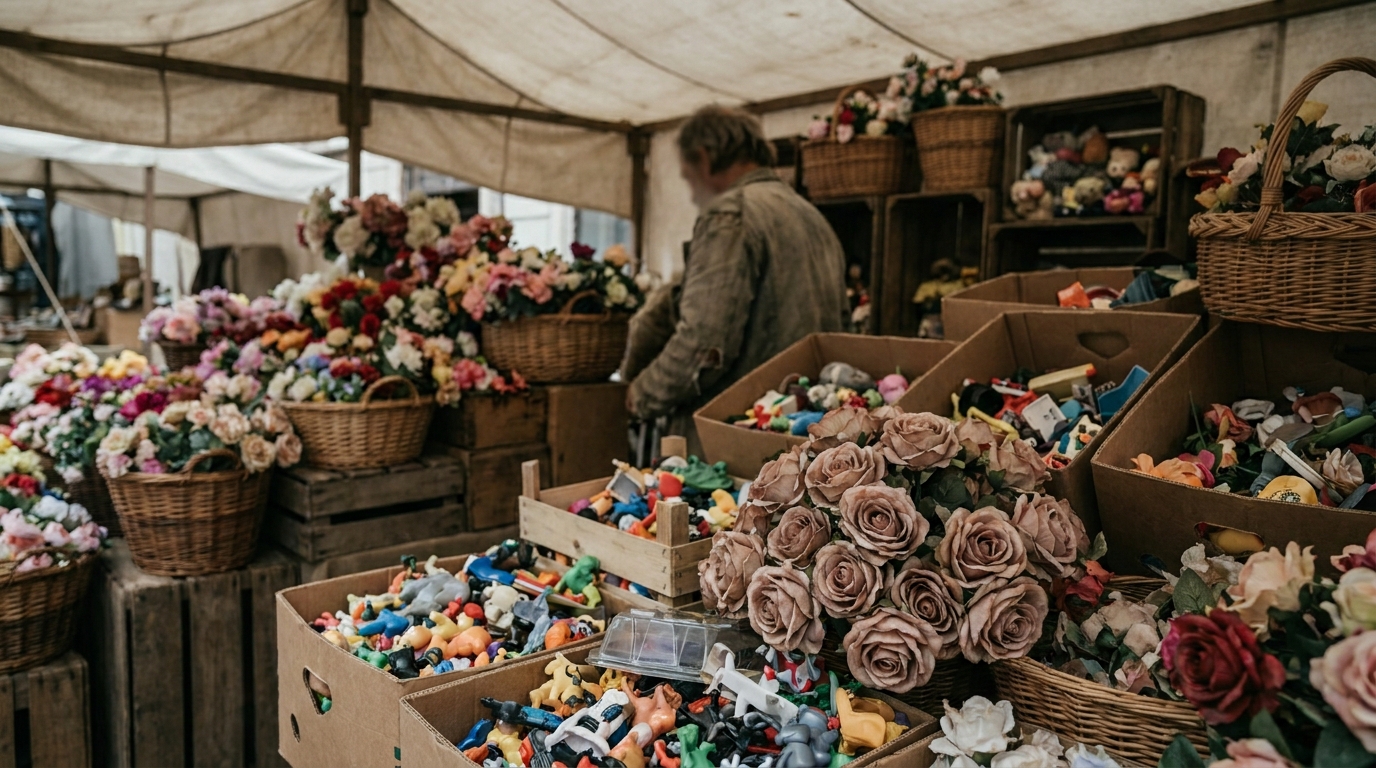
You can spot the first timers in District 1 by mid morning. They arrived at nine with one product in mind, usually jewellery or a particular toy, and by noon they are still on the same floor, twenty booths deep in artificial flowers they never planned to look at. The district invites that kind of drift. It also punishes it, because a day spent wandering is a day not spent comparing the handful of booths that actually matter for your order. This is the corner of the complex where a Yiwu market agent earns the commission simply by keeping a buyer pointed in one direction until the job is done.
One note before the detail, because it confuses people with a booth address in hand. This district is written as Yiwu Market District 1, as Futian Market District 1 and as Yiwu International Trade City District 1, depending on whose signage, invoice or business card you are reading. They are all the same building.
District 1 sits at the older end of the Futian complex and holds three large product worlds: toys, artificial flowers and plants, and the small goods universe of jewellery, hair accessories and fashion ornaments. Each of them behaves differently as a purchase, so it pays to take them one at a time.
The toy floors
Toys here run from plush animals and plastic novelties through to electric toys, inflatables, puzzles and educational lines. The booths are showrooms, not shops. Almost everything on the shelves is a display of what can be ordered rather than stock you can buy and carry away, and the person behind the desk might be the factory owner, a hired salesperson, or a trader who represents several workshops at once. Whether the booth is the factory matters less than most buyers assume, and we cover that question properly in our piece on how Yiwu trade is structured, so here we will leave it at one sentence: judge the price, the sample and the paperwork, not the sign above the door.
Toy buying in District 1 is assortment heavy. A booth will sell you a single design at its stated minimum, but the conversation usually goes better when you spread an order across a range from the same seller. One carton of the dinosaur, one of the digger, two of the plush rabbit in mixed colours. Sellers are used to composing mixed orders like this and it tends to soften the per design minimums.
The thing buyers most often get wrong with toys is not price. It is paperwork. Toys sold in most destination markets carry testing and marking obligations, and those obligations belong to your country, not to the seller, so a booth will rarely raise the subject on its own. Ask early whether test reports exist for your market, treat “we can arrange it” as the opening of a conversation rather than an answer, and confirm the actual requirements with a testing lab or your own authorities before money moves.
Artificial flowers, and why they fill so much space
Nothing quite prepares you for the artificial flower aisles. Single stems, bushes, garlands, hanging vines, potted arrangements, wedding arches, whole fake hedges. The booths are dense, green and nearly identical at first glance, which is exactly the problem. The differences that decide whether your customers reorder are quiet ones: the weight and feel of the fabric petal, how the stem is wired, whether the colour is printed or dyed through, how many flower heads a bush actually carries once you count them.
Pricing follows material. Two roses that look the same in a photo can sit far apart in price because one uses a heavier touch fabric and a fuller head. If you buy on price alone in this category you will usually receive exactly what you paid for, which is a thinner petal and a lighter stem. Take samples of the grade you intend to order and keep one in your office, because when the bulk goods arrive the only fair comparison is the sample in your hand, not your memory of a crowded aisle.
Seasonality matters more here than buyers expect. Festive stems and seasonal colours are produced in waves, and if your order lands after the wave for that colourway has passed, the dye lot on the reorder may not match your first batch precisely. If colour continuity matters to your shelves, say so when ordering and keep a cutting from the first delivery.
Jewellery and hair accessories: small goods at a fast fashion pace
The jewellery and hair accessory zone moves at a different speed from everything around it. Designs turn over constantly. The clip you photographed in spring may be gone by autumn, replaced by whatever is currently moving on short video platforms. That churn is a feature if you sell trend goods and a trap if you are building a stable catalogue, because the booth is under no obligation to keep making your best seller.
Goods are quoted per piece or per dozen, and the per piece numbers are tiny, which changes where the real costs sit. On a carton of 144 hair clips the product is often the smallest line on the invoice once you add packing cards, polybags, barcode labels and freight. Agree the packaging spec in as much detail as the product spec. A clip carded and bagged for retail is a different purchase from the same clip loose in a bulk bag.
Plating is the quality question in this zone. A sample that looks bright on the counter can tarnish quickly if the plating is thin, and some destination markets restrict certain metals in jewellery, so this is another category where you confirm the rules for your own country rather than relying on the seller’s assurance. If skin contact goods are your business, budget for testing.
Where District 1 orders go wrong
- Ordering from photographs of a display wall without pulling samples. Displays fade, and display pieces are sometimes the best examples the booth owns.
- Leaving packaging vague. “Normal packing” means whatever the factory did for the last customer, which may not survive your courier or suit your shelf.
- Assuming the booth holds stock. Most orders here are made to order, and lead times stretch before major holidays.
- Skipping the boring photograph. Shoot the booth card, the product and the written spec together in one frame so nobody has to reconstruct the deal from memory later.
Samples deserve their own discipline, and the sample you approve can still differ from the shipment for reasons worth understanding. We have written separately about why that happens, so we will not repeat it here.
How minimums and prices behave in this district
Minimums in District 1 are modest by wholesale standards but they apply per design and often per colour, which is where new buyers get caught. Ten designs in three colours each is thirty minimums, not one, and the polite way through is to concentrate your order on fewer sellers and negotiate the spread with each of them.
Haggling moves in small steps. These are low value goods and the seller’s margin per piece is thin, so grinding on unit price rarely gets far. The levers that genuinely move the number are quantity across designs, packaging simplification and material grade. Ask what changes the price rather than just asking for a lower one. It is a more useful question and sellers respond to it more honestly.
Before you order in District 1
Pull samples of everything you intend to buy. Agree the packaging in writing next to the product spec. For toys, settle the testing question before the deposit, not after. Confirm the lead time against the holiday calendar, because a promise made in December means something different from the same promise made in March. And decide before you fly whether you will have someone on the ground when the goods are produced, because a check in Yiwu is cheaper than a dispute after the container sails.
We walk these aisles most weeks with buyers and consolidate their cartons in our own warehouse across town. If District 1 is on your list, it is a good district to visit with a plan, and a very easy one to lose a day in without one.
Most of what a Yiwu District 1 sourcing agent actually gives you here is that plan, plus someone who has already seen which booths repeat themselves.