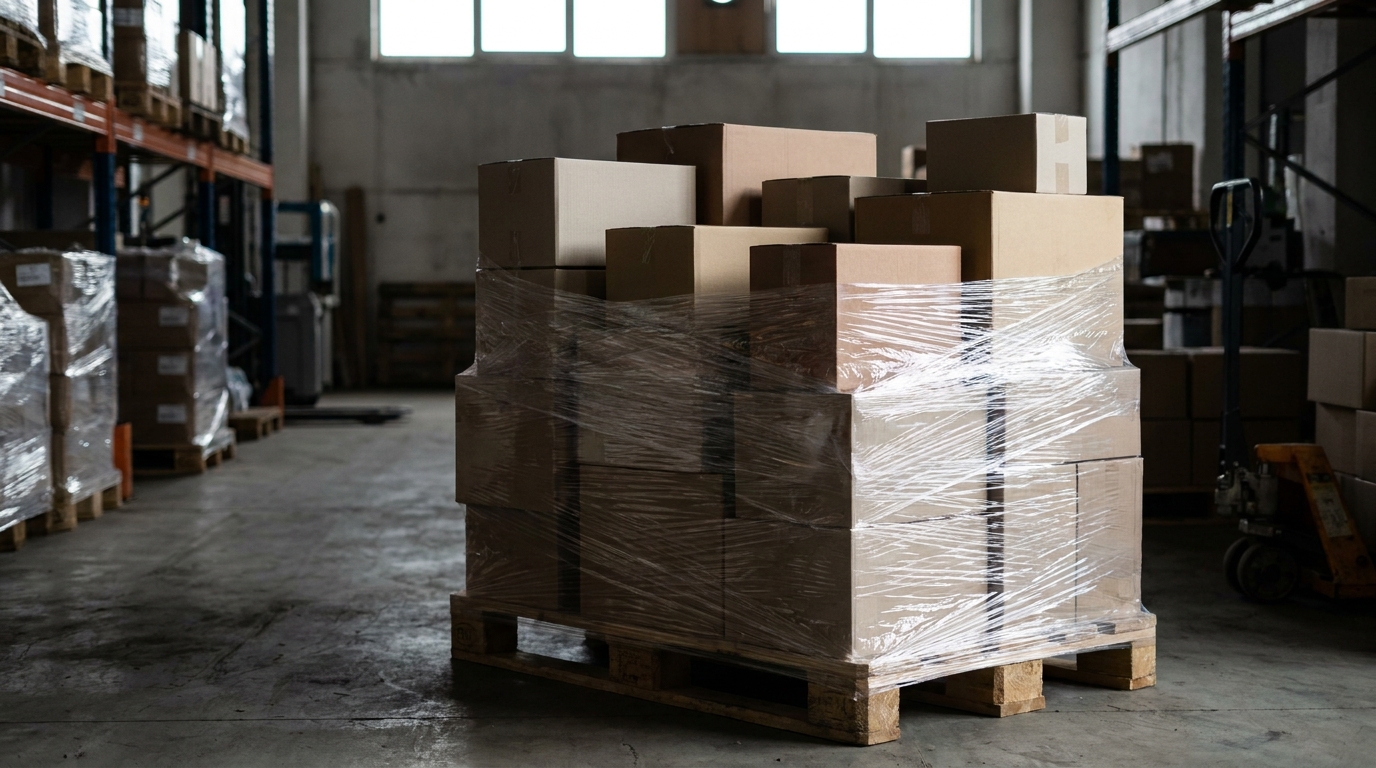
Most orders placed in Yiwu do not come from one supplier. A typical buyer walks the market for two or three days and ends up ordering from eight, twelve, sometimes thirty different booths. Each of those booths delivers separately, on its own schedule, in its own cartons. A Yiwu consolidation service exists to catch all of that in one place, check it, and turn it into a single shipment. That is the whole job, and this post explains how it actually runs day to day in our warehouse.
If you are still at the planning stage and wondering how to fill a container with goods from many suppliers, we cover that separately in our post on planning a mixed container from Yiwu. This one is about what happens after the orders are placed.
Why consolidation exists at all
Yiwu suppliers sell in market quantities, not container quantities. A booth selling hair accessories might take an order for twenty cartons. A booth selling stainless steel flasks might take an order for fifteen. Neither of those is a shipment on its own. Sending each one internationally by itself would be slow to arrange and expensive per carton, and you would end up managing a dozen separate deliveries at your end.
So the goods all come to one warehouse first. They wait there until everything has arrived, they get checked and recorded, and then they leave together. One booking, one set of paperwork, one delivery at destination. That is consolidation. It sounds simple, and the concept is. The work is in the details.
Step one: the warehouse becomes the delivery address
When an order is confirmed with a supplier, the delivery address on that order is the consolidation warehouse, not you. In practice this is usually arranged in Chinese, with the supplier’s own delivery driver or a local courier dropping the cartons at the warehouse door. Suppliers in Yiwu do this constantly. Delivering to an agent’s warehouse across town is completely normal for them and usually free or close to it.
What matters at this stage is that the supplier knows how to mark the delivery. Every incoming carton needs to be traceable to a specific buyer and a specific order. In our warehouse each client’s orders carry a reference, and suppliers are told to write it on the cartons or the delivery note. When that reference is missing, someone has to open cartons and guess, which is where mistakes start. A good Yiwu consolidation service is strict about this before the goods ever move.
Step two: receiving and checking
When a delivery arrives, the warehouse does not just stack it in a corner. Receiving properly means several things:
- Counting the cartons against the delivery note and against the order.
- Weighing and measuring the cartons, because those numbers drive the shipping cost later.
- Looking at the outside condition. A carton that arrives crushed or wet gets flagged the same day, while the supplier still has reason to fix it.
- Opening a sample of cartons to confirm the goods inside are the right product, the right colour, the right packing quantity.
- Photographing what was received and sending the photos to the buyer.
How deep the check goes depends on what you have asked for. A basic receiving check confirms the right goods arrived in the stated quantity. A fuller inspection, where someone checks workmanship and function against the sample, is a separate service and worth doing on anything you have not bought before. We describe what an inspection covers in its own post, so here I will just say this: the moment of receiving is the cheapest moment to catch a problem. The supplier is ten minutes away, the balance may not be fully settled, and nothing has shipped. Once the goods are on the water, every one of those advantages is gone.
Step three: waiting, which nobody enjoys
Here is the honest part. Consolidation means the shipment moves at the speed of the slowest supplier. If eleven of your twelve orders arrive within a week and the twelfth supplier is still waiting on fabric, everything sits. This is the most common source of frustration in the whole process, and there is no clever trick that removes it.
What a warehouse can do is keep you informed and give you the decision early. When one order is dragging, you should hear about it while there is still time to choose: wait for it, ship without it and send it later, or in some cases cancel it. What should never happen is silence for two weeks followed by “still waiting”. Ask any consolidation service you are considering how they report arrivals. A simple running list, updated as deliveries land, is worth more than any promise.
The waiting period is also when goods are stored, sometimes for days, sometimes for weeks. What storage involves, and what you should expect from it, is a topic on its own and we have a separate post on it.
Step four: preparing the actual shipment
Once everything has arrived and been checked, the shipment is put together. Depending on the goods and your instructions this can involve:
- Renumbering cartons into one continuous sequence for the whole shipment, so the packing list matches what is physically there.
- Applying shipping marks and any labels your side needs. Marking is its own subject with its own post, because getting it wrong causes real pain at destination.
- Repacking where a supplier’s carton is too weak or too empty to travel. Also its own post, because opening cartons is something to do carefully or not at all.
- Palletising, if the destination or the buyer wants pallets rather than loose cartons.
- Producing the final packing list: every carton number, its contents, quantity, weight and dimensions.
That final packing list is the document that makes the rest of the chain work. Customs brokers, freight forwarders and your own receiving staff all rely on it. When it is accurate, problems at destination are rare and small. When it is a rough guess typed from memory, they are not.
Where consolidation ends
Consolidation ends when the cargo is handed over for transport, whether that is a container loaded at the warehouse door or cartons trucked to a forwarder. What happens after that, the ports, the rail option, the documents that travel with the goods, belongs to the shipping side and we cover it in separate posts. The clean way to think about it: the warehouse’s job is to make sure that what leaves Yiwu is complete, correct, recorded and packed to survive. The transport side’s job is to move it.
What to ask before you rely on one
If you are choosing a Yiwu consolidation service, a few questions tell you most of what you need to know. Ask how incoming goods are identified to your account. Ask what a standard receiving check includes and what costs extra. Ask how quickly you hear when something arrives damaged or short. Ask who writes the packing list and from what. And ask what happens when one supplier is late, because one supplier is always late eventually.
We run our own warehouse and consolidation space in Yiwu with our own staff, so these steps are things we do daily rather than a description of someone else’s process. If you want to talk through how your orders would flow through it, contact us and we will walk you through it with your actual product list in front of us.